
Introduction to Z-1 Glass Ordering Options
As demand grows for durable, safe, and visually appealing glass in both architectural and commercial applications, Z-1 glass has emerged as a leading choice. Known for its superior structural integrity, exceptional optical clarity, and advanced laminated technology, Z-1 glass outperforms conventional options like PVB laminated glass and SGP laminated glass. Whether you’re designing a massive curtain wall or a boutique glass feature, procurement strategies can greatly affect both cost and efficiency.
This guide explores the practical and financial implications of purchasing Z-1 glass in bulk versus ordering smaller, custom quantities. From price and availability to delivery lead times and waste management, understanding the trade-offs will help you optimize your project planning and procurement process.
What Is Z-1 Glass and Why Is It Premium?
Z-1 glass is an advanced laminated glass type developed for structural applications where safety, sound insulation, and longevity are crucial. It integrates interlayers that enhance impact resistance and reduce delamination over time. Z-1 is widely used in:
- High-rise façades
- Railings and partitions
- Acoustic glazing systems
- Impact-resistant safety glazing
Due to its high performance, Z-1 glass manufacturers offer customizable options like coating, thickness, shape, and edge finishes, making it suitable for both bulk procurement and made-to-order units.
Cost Implications of Bulk vs Small Orders
One of the key concerns for buyers is how order size impacts the Z-1 glass price. Generally, bulk purchases offer several cost-saving opportunities:
- Economies of scale: Larger orders reduce the per-square-meter cost of glass, as fixed manufacturing and handling costs are distributed over a bigger volume.
- Reduced shipping charges per unit: Logistics become more efficient with full pallet loads or container shipments.
- Negotiation leverage: Buyers placing high-volume orders are more likely to receive discounts or value-added services such as extended warranties or priority scheduling.
On the other hand, custom small orders come with:
- Higher per-unit costs
- Increased setup time for bespoke specifications
- Potential delivery delays, especially if special coatings or dimensions are involved
Still, small orders are necessary when dealing with limited-space installations, replacement panels, or architectural elements requiring precise dimensions.
To better understand the variables affecting costs, consult Z-1 Glass Pricing Guide: Cost per m² and Variables.
Flexibility and Customization
Bulk Z-1 glass orders typically follow standardized dimensions, finishes, and coatings. This makes them ideal for large projects where uniformity and repeatability are priorities. However, this comes at the cost of reduced flexibility:
- Limited variation in size or edge treatment
- Less adaptability to last-minute design changes
Custom small orders, meanwhile, are tailored to specific needs, offering greater design freedom:
- Irregular shapes or curves
- Customized tints, coatings, or logos
- Special laminated interlayers for soundproofing or blast resistance
For projects involving Z-1 glass in design elements such as branded façades or artistic partitions, the benefits of small, tailor-made orders outweigh the higher cost.
Lead Times and Production Cycles
Z-1 glass manufacturers often schedule bulk orders into their standard production cycles. This can speed up lead times, especially for high-demand standard panels. Additionally, bulk orders are more likely to be stocked in advance or produced in advance batches.
In contrast, small custom orders might:
- Require additional tooling or setup
- Be scheduled between larger production runs
- Have longer lead times depending on coating or thickness specifications
If time is a constraint, it’s crucial to weigh the delivery schedule before choosing between bulk and custom orders.
Waste Management and Inventory Handling
For large projects, bulk orders can reduce unit cost but may lead to overordering and waste if proper planning isn’t done. Unused Z-1 panels can become obsolete due to:
- Design changes
- Unexpected sizing issues
- Regulatory changes
In contrast, custom small orders align more closely with real-time project needs, reducing excess inventory and storage requirements. This also allows better adaptability when architectural specs evolve.
However, it’s important to ensure that small orders are within warranty-protected specifications. Refer to Z-1 Glass Warranty and Tips for Preventive Maintenance to learn how maintenance and documentation can help preserve coverage, especially for sporadic or phased deliveries.
Logistics and Handling Considerations
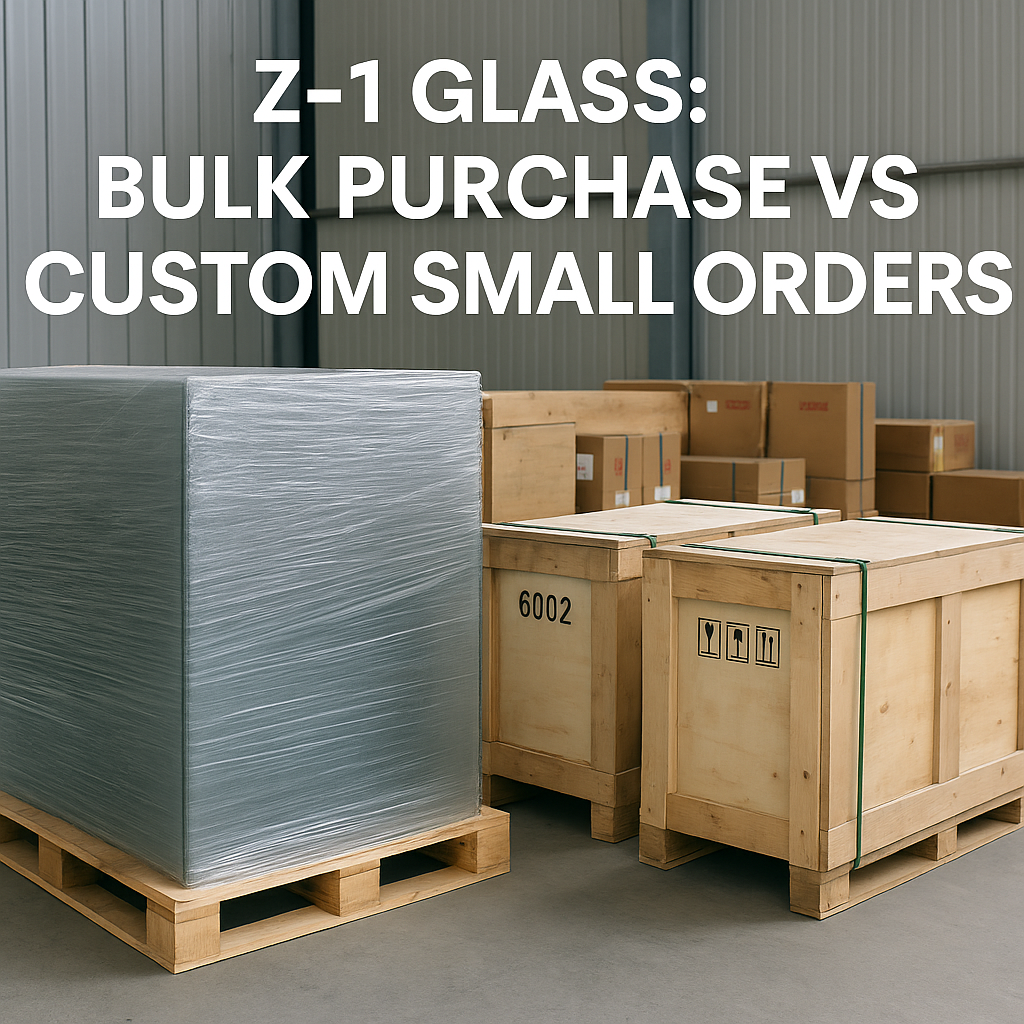
Bulk orders are generally palletized and shipped in secure containers, often with protective interlayers and edge blocks. This improves handling efficiency and lowers risk of breakage.
With small orders, glass is often crated or boxed in smaller batches, requiring more careful handling. Delivery scheduling also becomes more complex, especially when working across multiple locations or phases.
Nonetheless, small orders provide greater agility for contractors handling renovations or working in constrained sites where storage is limited.
Strategic Approach: Hybrid Ordering
Many architectural projects today use a hybrid approach, combining bulk and custom ordering:
- Bulk for core structural units (e.g., standard window modules)
- Custom small orders for design highlights or replacements
- Phased deliveries aligned with construction timelines
This allows stakeholders to take advantage of economies of scale while maintaining the flexibility to adapt to design shifts or site constraints.
Conclusion: Choosing the Right Procurement Method for Z-1 Glass
When weighing the pros and cons of bulk purchase vs custom small orders for Z-1 glass, consider these key questions:
- What is the scale and complexity of your project?
- Do you have design elements requiring bespoke solutions?
- Is your timeline flexible or fixed?
- How much storage space and handling capacity does your site have?
- Are you trying to optimize for price, customization, or both?
In large-scale projects where uniformity, cost-efficiency, and speed are top priorities, bulk ordering is typically the best route. For projects with unique design requirements or limited site access, custom small orders provide the precision and flexibility necessary for flawless execution.
For more insight into cost drivers like thickness, coatings, and shipping, refer to Z-1 Glass Cost Factors: Thickness, Coating, Location.
In either case, partnering with experienced Z-1 glass manufacturers and installers ensures you receive quality materials, precise specifications, and a seamless installation process that maximizes the value of your glass investment.