
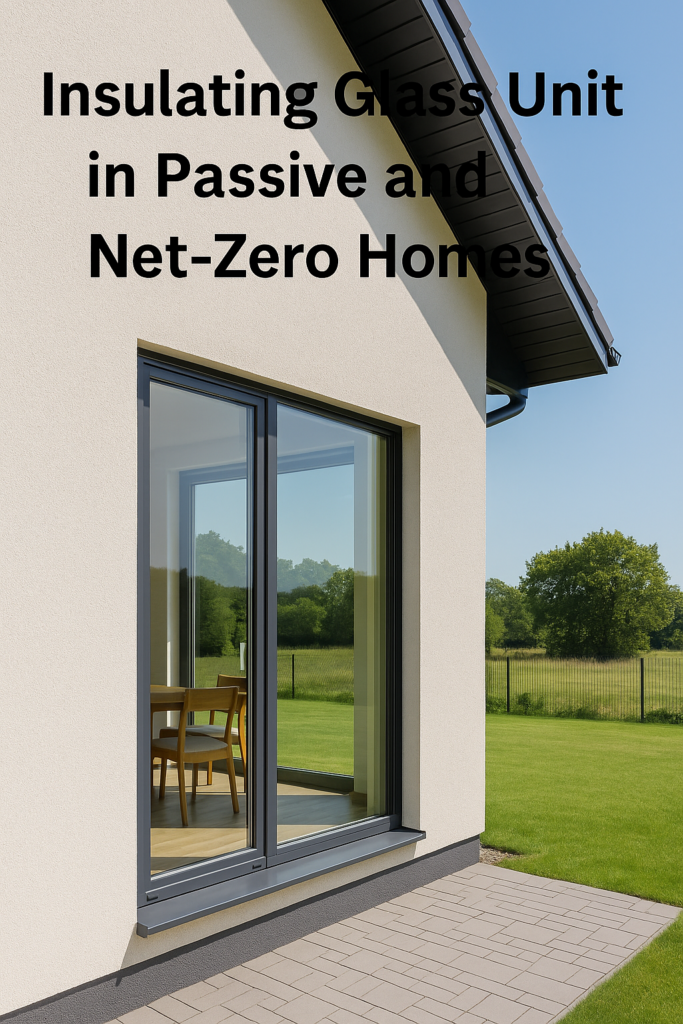
Introduction: Why IGUs Are Essential to Future-Ready Homes
As climate change and energy costs rise, architects and homeowners alike are turning toward Passive House and Net-Zero Energy standards to guide the next generation of residential construction. At the heart of these building envelopes is the Insulating Glass Unit (IGU)—a high-performance glazing solution critical for reducing energy loss, maintaining indoor comfort, and supporting long-term sustainability.
This article explores how IGUs help passive and net-zero homes achieve performance goals, reduce emissions, and qualify for leading green building certifications.
What Is an Insulating Glass Unit?
An Insulating Glass Unit is a sealed multi-pane window system that reduces heat transfer through the use of inert gas fills, low-emissivity coatings, and thermally broken spacers. By limiting thermal bridging and air leakage, IGUs are a central component in designing ultra-efficient, airtight building envelopes.
Whether in double or triple-pane configurations, IGUs are indispensable for meeting the high-performance standards of passive and net-zero homes.
Passive House and Net-Zero Defined
- Passive House (Passivhaus): An energy standard that emphasizes envelope airtightness, insulation, and balanced ventilation to minimize active heating and cooling loads.
- Net-Zero Energy: A home that produces as much energy as it consumes annually, typically by combining high-efficiency systems with on-site renewable energy.
Both standards depend heavily on advanced building envelope performance—making IGUs vital for success.
How IGUs Enable Passive House Performance
1. Thermal Insulation and Airtightness
Triple-glazed IGUs with argon or krypton gas and low-E coatings provide extremely low U-values—often below 0.15 BTU/h·ft²·°F (0.85 W/m²·K)—well within Passive House envelope guidelines.
2. Elimination of Thermal Bridging
Warm-edge spacers and insulated frames prevent thermal bridging around the perimeter of windows and doors, maintaining consistent indoor temperatures.
3. Solar Gain Optimization
IGUs can be tuned to allow solar heat gain in winter and limit it in summer through:
- Spectrally selective coatings
- Tinted glass
- Orientation-specific glazing
4. Noise Reduction
Laminated and hybrid IGUs reduce external noise—an important comfort factor in urban passive home locations.
Role of IGUs in Net-Zero Home Design
1. Energy Load Minimization
Reducing heating and cooling demand is critical to downsizing HVAC systems and aligning with renewable generation capabilities. IGUs significantly reduce building energy loads.
2. Renewable Energy Optimization
By reducing operational energy requirements, IGUs allow rooftop solar systems or ground-source heat pumps to cover a larger percentage of energy needs.
3. Carbon Emission Reductions
See urban emissions data in Insulating Glass Unit Cuts Emissions in Urban Builds.
4. Durability and Lifecycle Alignment
High-quality IGUs last over 25 years, aligning with the durability needs of long-term net-zero energy modeling.
Learn about full lifecycle performance in Insulating Glass Unit Supports Circular Construction.
Recommended IGU Configurations for Passive and Net-Zero Homes
| Configuration | U-Value (W/m²·K) | Key Features |
|---|---|---|
| Triple-pane, argon-filled | 0.8–1.0 | Low-E coatings, warm-edge spacers |
| Triple-pane, krypton-filled | 0.6–0.8 | Higher insulation, compact profiles |
| Hybrid IGU with laminated | 0.9–1.1 | Acoustic control and improved security |
| IGU with recycled content | 0.9–1.2 | Sustainability, EPDs, reduced embodied carbon |
Read about material optimization in Insulating Glass Unit and Recycled Content Integration.
Installation Considerations for Passive and Net-Zero Homes
1. Airtightness and Thermal Bridge Mitigation
- Seal IGUs to wall assemblies using airtight membranes
- Use thermal break frames
- Avoid metal clips or fasteners that bridge inside to outside
2. Orientation and Glazing Selection
- South-facing façades may use higher solar gain IGUs
- North or shaded elevations require lower SHGC to prevent heat loss
3. Window-to-Wall Ratio (WWR)
- Maintain WWR between 15%–30% of the façade to balance daylight and insulation
4. Shading and Landscape Integration
- Use overhangs, deciduous trees, or pergolas to manage passive solar heat
- For natural shading strategies, explore Bright View Landscape Core Benefits for Homeowners
Certification and Performance Standards
Passive House Institute (PHI) Certification
- IGUs must meet U-value and SHGC requirements
- Frame and glazing units must be PHI-certified
ENERGY STAR and National Programs
- High-performance IGUs help meet DOE Zero Energy Ready Home (ZERH) and ENERGY STAR v3.2 requirements
Green Building Certifications
- Contribute to LEED, WELL, and PHIUS+ credits
See performance alignment in Insulating Glass Unit for Green Building Certifications.
Maintenance and Longevity in Passive/Net-Zero Design
Minimal Maintenance Requirements
- Inspect edge seals every 2–3 years
- Clean glass with pH-neutral, non-abrasive solutions
- Recalibrate any dynamic or smart coatings as needed
Retrofitting with IGUs
- Existing homes can achieve Passive House EnerPHit standards by replacing legacy windows with high-performance IGUs
Conclusion: IGUs Power the Homes of Tomorrow
The Insulating Glass Unit is a fundamental component in Passive and Net-Zero Energy Home design. Through superior insulation, solar optimization, acoustic control, and durable, sustainable construction, IGUs help transform homes into climate-resilient, energy-efficient spaces.
Whether you’re building new or retrofitting for performance, specifying the right IGU can help meet energy goals, improve occupant comfort, and qualify for the most demanding green certifications—making IGUs an essential investment in the future of housing.