
In today’s construction and home renovation industries, energy efficiency and comfort are top priorities. Choosing the right type of glass plays a major role in achieving these goals — especially when it comes to managing solar heat, light transmission, and insulation. Among the most common energy-efficient glazing options are glass low e and reflective glass.
Both are designed to reduce energy consumption and improve comfort levels, but they work in different ways. While glass low e focuses on controlling thermal transfer through a nearly invisible coating, reflective glass relies on its metallic film to control solar energy and add visual privacy.
This article breaks down their differences in composition, performance, design, and best applications, helping you decide which option best suits your project or property.
Understanding the Basics of Glass Low E
The term Low E stands for low emissivity, referring to glass that features a microscopically thin metallic coating designed to minimize the amount of infrared and ultraviolet light that passes through the glass.
In simpler terms, glass low e acts as an intelligent filter — allowing natural daylight to enter your home while reflecting heat energy. This coating is thinner than a human hair, yet powerful enough to create a measurable difference in your home’s comfort and energy bills.
How Glass Low E Works
The coating on glass low e reflects long-wave infrared energy (heat) back toward its source. During winter, this helps trap indoor warmth, keeping interiors cozy. During summer, it reflects external heat away, helping your home stay cooler.
Because it allows visible light to enter while managing invisible heat radiation, glass low e enhances brightness without the drawbacks of glare or heat buildup.
For installation and processing, precision tools such as a fabrication table are used to ensure coating alignment, glass accuracy, and edge protection.
Two Main Types of Glass Low E: Hard Coat and Soft Coat
There are two types of low-emissivity coatings — hard coat and soft coat — each offering unique benefits depending on climate and usage.
Hard-Coat Low E (Pyrolytic)
- Created by fusing the coating directly onto the glass during manufacturing.
- Extremely durable and scratch-resistant.
- Allows slightly more solar heat gain, making it ideal for cold climates.
- Provides moderate insulation benefits.
Soft-Coat Low E (Magnetron Sputtering)
- Manufactured using a vacuum deposition process, creating multiple precision layers.
- Offers superior thermal insulation and lower emissivity.
- Requires installation in a sealed or laminated unit to protect the coating.
- Ideal for temperate or warm climates.
For a deeper understanding of how strength and structure differ between coatings, see Which Is Stronger: Glass Low E or Laminated Types?.
Understanding Reflective Glass
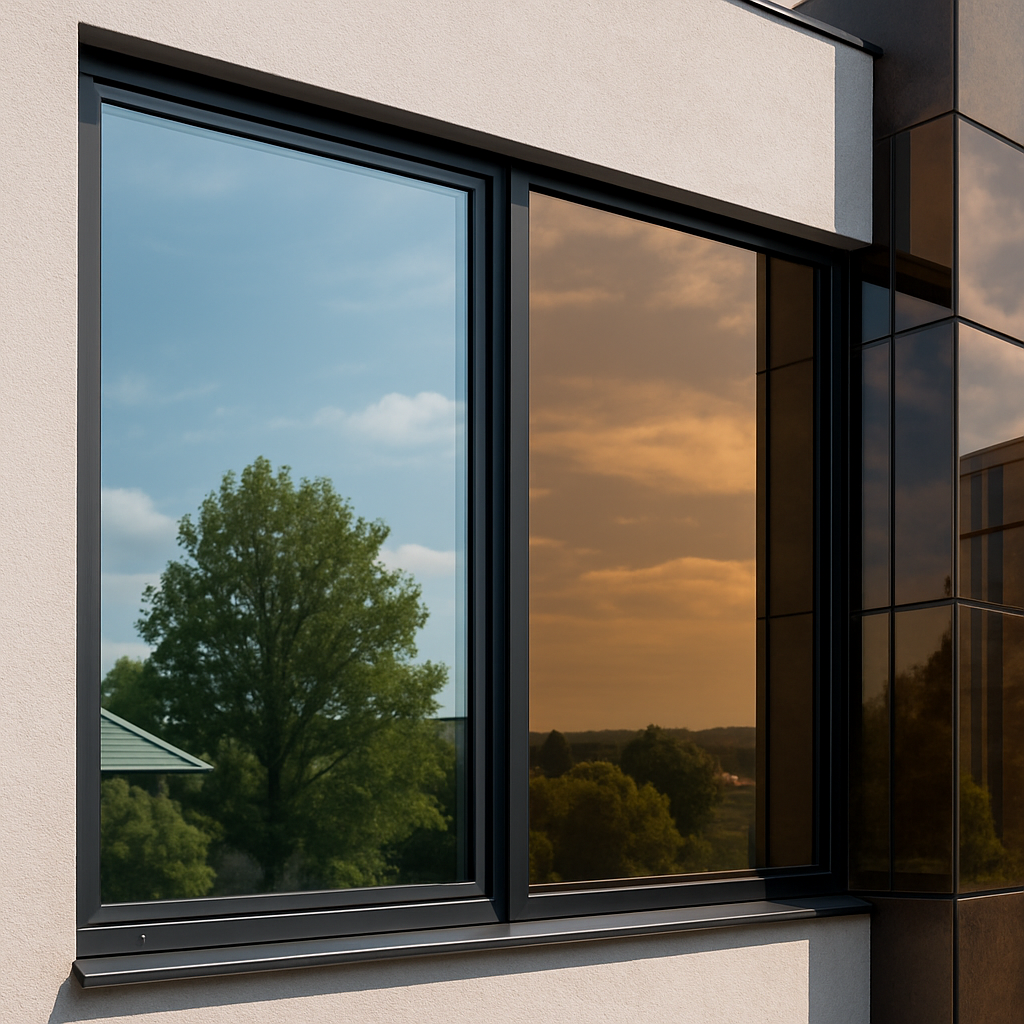
Reflective glass is created by applying a thin metallic film (often aluminum, titanium, or chromium) to one side of the glass surface. This coating reflects a significant portion of visible and infrared light, reducing glare and solar heat gain.
When viewed from the outside, reflective glass appears like a mirror, creating privacy during the daytime and offering a distinctive modern look.
It’s available in various tones — including bronze, silver, gold, and blue — making it popular for both commercial and residential applications where aesthetics and privacy are priorities.
How Reflective Glass Works
Reflective glass absorbs and reflects solar radiation. By bouncing sunlight back outward, it reduces the amount of heat entering a building and prevents harsh glare from direct sunlight. This is particularly effective in hot climates or west-facing façades.
However, unlike glass low e, reflective coatings also affect visible light transmission and external appearance. They can make interiors slightly darker, and at night, when interior lights are on, the reflective property is reversed — allowing visibility from outside.
Key Differences: Glass Low E vs Reflective Glass
While both glass low e and reflective glass contribute to energy efficiency, their functional mechanisms and design purposes differ significantly.
| Aspect | Glass Low E | Reflective Glass |
|---|---|---|
| Primary Function | Reduces heat transfer and UV radiation | Reflects sunlight to reduce glare and solar heat |
| Coating Type | Transparent metallic layer | Opaque or tinted metallic film |
| Light Transmission | High – allows natural daylight | Moderate – darker tint, mirror-like |
| Thermal Insulation | Excellent, reduces U-value | Moderate, focuses on solar control |
| Appearance | Clear, neutral | Mirror-like or tinted |
| Best Climate | All climates (varies by coating type) | Hot and sunny climates |
| Privacy | Minimal during day/night | Strong daytime privacy |
| Energy Efficiency | Superior overall | Good for solar control only |
In essence, glass low e focuses on thermal efficiency and comfort, while reflective glass emphasizes privacy and glare reduction.
Thermal Performance: Efficiency Matters
When comparing thermal metrics, glass low e consistently outperforms reflective glass in energy savings. Its U-values (a measure of heat transfer) are significantly lower, meaning less heat escapes during winter.
Meanwhile, reflective glass performs better in terms of Solar Heat Gain Coefficient (SHGC) — blocking solar radiation from entering in hot climates but at the cost of reduced visible light.
In other words:
- Glass low e = thermal control and comfort
- Reflective glass = solar reflection and aesthetics
This energy efficiency advantage is also why low-e coatings are integral to Passive House designs, as explored in Why Is Glass Low E Better Than Double Glazing Only?.
Visual Appearance and Aesthetic Value
If you value natural light and transparency, glass low e is the better option. Its coating is nearly invisible, allowing architects to maintain a sleek, modern façade without altering color or clarity.
Reflective glass, on the other hand, adds a decorative element to architecture. Its reflective surface creates a striking visual, blending buildings with the environment or offering a futuristic style. It’s often used in office towers, hotels, and luxury homes to enhance exterior appeal.
To create design harmony between indoor and outdoor spaces, architects often draw inspiration from landscape architecture trends — see Designers Define Landscape Trends in Modern Gardens for ideas on integrating glass aesthetics into modern exteriors.
Durability and Handling in Fabrication
During production, both glass types require precise handling and advanced tools. Glass low e coatings, especially soft coats, are sensitive to scratches and contamination before sealing. They require clean environments and professional machinery, such as Battery Joint Setter systems, which provide stability and control during glass alignment.
Reflective glass, while more resilient during handling, still demands temperature control and coating protection to maintain its reflective quality over time.
Cost and Maintenance
Glass low e tends to be more expensive due to the complexity of its coating and manufacturing process. However, it provides better long-term energy savings, which can offset the initial investment.
Reflective glass is generally more affordable but may require regular cleaning to maintain its mirror-like finish. Over time, dirt buildup can diminish its reflectivity and appearance.
When comparing lifecycle value, glass low e offers superior ROI thanks to its year-round thermal efficiency, reduced HVAC loads, and lower carbon footprint.
Which One Should You Choose?
The choice between glass low e and reflective glass depends on your project’s goals, climate, and design vision.
Choose Glass Low E if:
- You want optimal thermal insulation and energy efficiency.
- Natural light and comfort are top priorities.
- You’re building to green or Passive House standards.
- You prefer a clear, neutral glass appearance.
Choose Reflective Glass if:
- You’re in a hot or tropical climate where solar control is crucial.
- Privacy and glare reduction are important.
- You want a decorative, modern façade with mirrored tones.
- You’re working within a moderate budget but still want energy control.
For more insight into how coatings affect performance and color, visit What Makes Glass Low E Superior to Tinted Glazing?.
The Future of Energy-Efficient Glazing
Modern window technologies are evolving rapidly, blending the best of both worlds. Some advanced glass types now combine low-e coatings with reflective finishes, offering hybrid performance that delivers both insulation and solar control.
Whether for residential, commercial, or architectural projects, choosing the right glazing type ensures not only comfort but also a long-term contribution to energy sustainability.
Conclusion
Both glass low e and reflective glass offer valuable benefits for energy-efficient architecture — but they serve different purposes.
If your goal is to maximize comfort, minimize energy bills, and retain natural light, glass low e is the superior choice. If your focus is aesthetic appeal, privacy, and solar control, reflective glass may be the better fit.
Ultimately, the most effective designs often combine both technologies strategically across different orientations and spaces — pairing beauty, efficiency, and performance into a single smart glazing solution.