
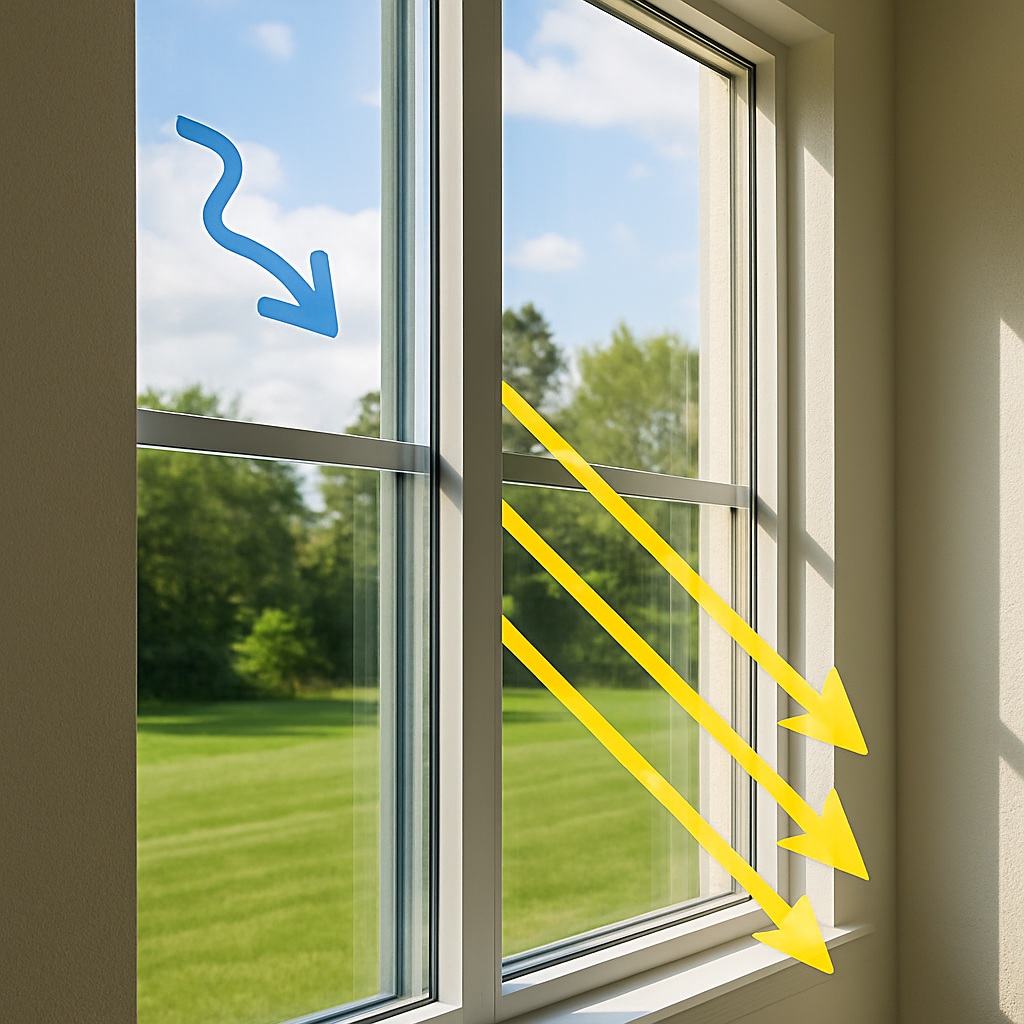
Low-emissivity glazing is one of the most powerful tools for cutting energy use and improving comfort — but where you put the coating matters just as much as which product you choose. Install it on the wrong surface and many of the most valuable low e glass benefits quietly disappear.
This is why glass manufacturers talk about “surface #1, #2, #3, #4” in an insulated glass unit (IGU). Orientation – indoors vs outdoors – determines how much heat the coating reflects, how much solar gain you get, and even how long the system lasts.
In this guide, we’ll unpack how low-E works, what changes when it’s installed on interior vs exterior surfaces, and how to get the best performance from every window you specify or replace.
Quick refresher: how low-E glass actually works
Low-E (low emissivity) glass is standard float glass with a microscopically thin, transparent metallic coating – typically layers of silver or metal oxides – that’s about 500 times thinner than a human hair.
That coating interacts with different parts of the solar spectrum:
- UV (≈310–380 nm) – causes fading of fabrics, flooring and artwork.
- Visible light (≈380–780 nm) – the daylight we want to keep.
- Infrared (IR, 780+ nm) – perceived as heat (short-wave IR from the sun, long-wave IR re-radiated by warm surfaces).
Low-E coatings are engineered to:
- Block or reflect UV and IR – to reduce heat transfer and fading
- Transmit visible light – to preserve brightness and daylighting
A standard clear glass pane has an emissivity around 0.84 (it radiates heat quite easily), while a good soft-coat low-E glass can have emissivity as low as 0.02, meaning it reflects most long-wave heat back toward its source. That high reflectivity is the core of most low e glass benefits.
Why surface orientation matters in an IGU
In a typical double-glazed unit, we talk about four surfaces:
- Surface #1 – Faces the outdoors (outside of the outer pane)
- Surface #2 – Inside face of the outer pane, facing the air gap
- Surface #3 – Outside face of the inner pane, facing the air gap
- Surface #4 – Faces indoors (room side of the inner pane)
Where you put the coating changes what it “sees”:
- Exterior-oriented coatings (#1 / #2) interact first with solar radiation, so they strongly influence solar heat gain and overheating.
- Interior-oriented coatings (#3 / #4) interact more with long-wave heat inside the building, so they strongly influence heat retention and comfort.
Most manufacturers therefore recommend:
- Solar-control low-E → usually on surface #2 (just inside the outer lite)
- Passive / high-gain low-E → often on surface #3 or #4 for better winter performance
Get the surface wrong and you can flip those behaviours – sometimes dramatically.
Key low E glass benefits – and how installation surface changes them
1. Thermal insulation and U-value
What you want:
Low U-values (less heat loss) and warm inner glass surfaces to eliminate cold drafts and condensation.
When coating is correctly oriented (e.g. #2 + #3 / #4):
- The low-E layer reflects long-wave IR back into the room in winter.
- The interior surface stays warmer, so occupants feel comfortable even near large windows.
- You get the advertised U-value from the product data sheet.
When installed on the wrong surface:
- A coating placed on #1 (fully exterior) sees more weathering and provides less benefit to interior heat retention.
- A coating that’s meant for #2 but installed on #4 may alter gas-fill performance and convective behaviour in the cavity, so the real U-value can be worse than lab values.
- In extreme cases, condensation risk can actually increase because the inner surface runs cooler than expected.
Bottom line: Many of the headline low e glass benefits – especially big drops in heating energy – assume correct interior vs exterior orientation. Mis-placing the coating erodes those gains.
2. Solar heat gain and cooling loads
What you want:
For most modern houses and offices, you want to control solar heat gain – enough winter sun in, less summer overheating – while still making the most of daylight.
Correct exterior-biased installation (typically solar-control on #2):
- The coating “sees” the sun first, reflecting a large share of short-wave IR before it even enters the cavity.
- This lowers the Solar Heat Gain Coefficient (SHGC) and reduces air-conditioning loads.
- Rooms stay bright but much cooler, especially for big west and south-facing elevations.
If the same coating is installed on a more interior surface (#3 or #4):
- More solar energy passes through the outer lite and air gap, then is only partially reflected.
- The effective SHGC can increase, undermining the “cooling season” benefits you paid for.
- Glass edges and frames may run hotter, which can increase stresses and accelerate seal failures.
For a deeper look at installation-related performance issues, you can tie this topic together with What Low E Glass Benefits Require Careful Jobsite Handling, which explores how scratches, contamination and mishandling further alter real-world SHGC and U-values.
3. UV blocking and interior protection
One of the most underrated low e glass benefits is fading protection for floors, fabrics and artwork.
- A properly positioned low-E layer can cut UV transmission by 70–99%, dramatically slowing discoloration.
- If the coating is buried in the right place inside the IGU, it’s protected for decades and continues to filter UV.
When installed on the wrong surface:
- Exterior-exposed coatings can weather faster, reducing their UV-blocking performance over time.
- If a low-E film is added on the wrong side of an existing low-E IGU, you can end up with unexpected reflections and internal ghosting, and the UV numbers may no longer match either manufacturer’s spec.
That’s why orientation and stack-up should always be checked against the glass supplier’s documentation – especially in museums, galleries and retail environments where display protection is critical.
4. Comfort: hot-cold asymmetry near the glass
Occupant comfort is not just about room air temperature. Our bodies react strongly to radiant exchange with nearby surfaces – especially large cold or hot panes of glass.
With the coating on the correct interior-biased surface (#3 or #4):
- The inner lite radiates less heat to the night sky, so it stays closer to room temperature.
- People sitting near the window feel less “radiant chill” in winter and less “radiant blast” in summer.
- Draft perception drops because the temperature gradient across the room is flatter.
If that same unit is built with the low-E on an exterior-biased surface:
- The inner surface can run several degrees colder in winter.
- You may still save some energy, but occupants feel uncomfortable and often bump up the thermostat – cancelling part of the energy savings.
This is exactly why orientation is stressed in guidance such as Why Low E Glass Benefits Need Right Orientation at Install, which focuses on surface numbering and climate strategy.
5. Daylighting quality and glare
Low-E coatings are designed to have high visible light transmittance (VLT) and good light-to-solar gain ratios, so you can enjoy daylight without unacceptable glare or overheating.
Orientation affects:
- Reflected vs transmitted light: Exterior-facing coatings influence facade reflectivity and the appearance of the building from outside.
- Interior reflections: An overly reflective coating on #4 can create mirror-like effects at night, reducing clarity and causing visual discomfort.
When the wrong side is facing indoors:
- You may see more ghost reflections at night, especially in multi-pane setups.
- Screens and workstations near windows can suffer increased veiling glare if the inner surface reflectance is higher than intended.
These are the kinds of issues that also show up when installers ignore manufacturer orientation arrows during glazing.
Indoors vs outdoors: special cases where orientation really changes performance
Beyond standard facades, there are scenarios where “indoors vs out” becomes more nuanced:
Interior glazing and partitions
Using low-E glass in interior doors or partitions (e.g., around atria, winter gardens, or between conditioned and semi-conditioned spaces) can:
- Help keep conditioned air where you need it
- Reduce radiant asymmetry across zones
But here, both sides might be “indoors” in a conventional sense. The key is to:
- Place the coating facing the higher temperature side if you mainly want to contain heat.
- Avoid putting a soft-coat on a directly exposed, cleanable surface where it can be scratched; typically you still bury it within a laminated or IGU assembly.
Skylights and sloped glazing
With skylights, orientation and surface selection affect:
- Summer heat gain (critical in roofs)
- Risk of condensation on the interior lite
- Self-cleaning performance if combined with hydrophilic exterior coatings
Solar-control low-E is usually placed on the surface that first sees the sun, but in some cold climates a different configuration can improve winter solar gain. Again, manufacturer guidance is key.
Installation quality: the multiplier on low e glass benefits
Even with perfect surface orientation, poor installation can undo the advantages:
- Bad air sealing around frames allows convection paths that bypass your high-performance glass.
- Twisted or racked frames can stress sealed units, leading to premature seal failure and argon loss.
- Contaminants or scratches during handling can damage soft-coat surfaces before they’re safely enclosed.
To see how correct installation protects performance over the life of the building, it’s worth pairing orientation guidance with How Proper Installation Protects Low E Glass Benefits, which dives into frame integration, tolerances and on-site best practices.
For a more holistic look at how framing and fit amplify performance, you can also explore Where Low E Glass Benefits Improve If Frames Install Well, which focuses specifically on air-tightness, thermal breaks and sill detailing.
Practical tips for getting orientation right on site
To make sure the low e glass benefits you sold on paper actually show up in the finished building:
- Specify surface clearly in drawings
- Call out “Low-E on #2 surface” or “Low-E on #3 surface (room side of cavity)” directly in schedules.
- Use separate line items for passive vs solar-control coatings.
- Check manufacturer markings
- Many units ship with arrows or labels indicating which side faces out.
- Make “label check” a step in your site QA checklist.
- Use mock-ups for complex facades
- For mixed-use, deep overhangs, or highly glazed spaces, build and instrument a small mock-up to verify SHGC, glare and interior comfort.
- Coordinate with mechanical design
- Provide realistic U-values and SHGCs based on actual surface orientation so the HVAC designer sizes systems correctly.
- Train installers and subs
- A short toolbox talk on low-E direction, handling, and cleaning can prevent expensive re-work later.
Conclusion: orientation turns low-E from “good” to “exceptional”
Low-E glass has earned its reputation because it can:
- Cut heating and cooling loads dramatically
- Improve comfort by stabilising surface temperatures
- Protect interiors from UV damage
- Support bright, glare-controlled, daylight-driven spaces
But these low e glass benefits are not guaranteed by the coating alone. They depend heavily on whether that ultra-thin metallic layer is facing the right direction, on the right surface, and protected inside a well-installed frame.
Get orientation wrong, and you’ll still have a “low-E window” on paper – but with higher bills, poorer comfort, and disappointed clients. Get it right, and low-E glazing becomes one of the most cost-effective, high-impact upgrades in any project.
For a broader design perspective beyond the building envelope, it can also be helpful to zoom out to the site scale and think about how facades, planting, landforms and outdoor spaces work together. Resources like What Defines a Natural Landscape and Its Core Features offer useful context for integrating high-performance glass with climate-responsive landscape design.