
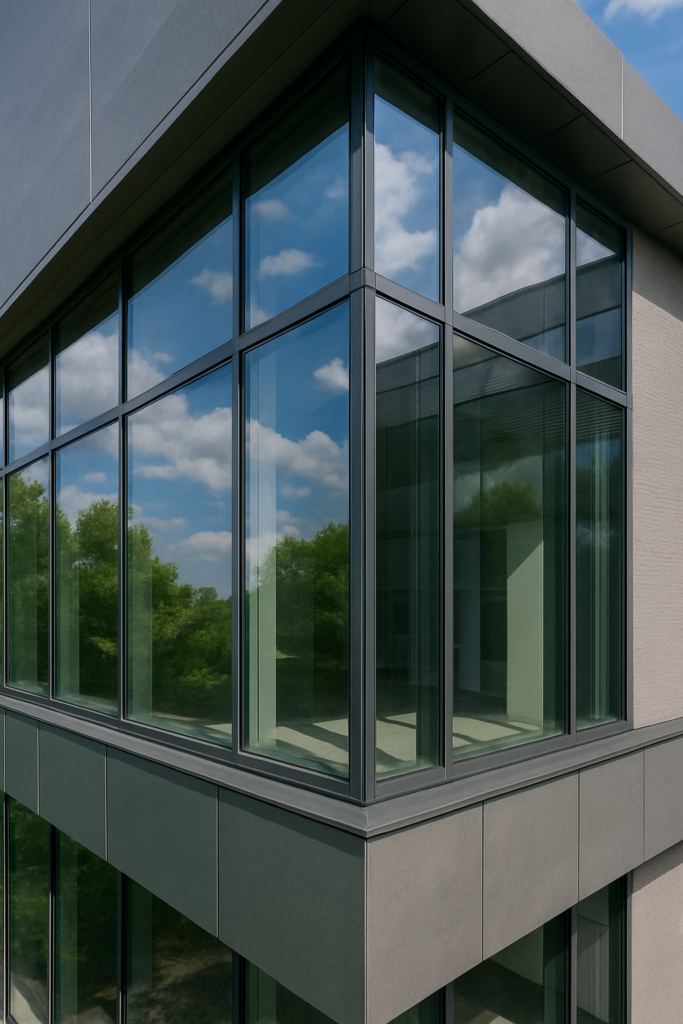
In modern buildings, we expect big windows, bright interiors and uninterrupted views without suffering from glare, overheating or sky-high energy bills. Achieving all three used to feel like a compromise: clear glass meant great daylight but poor comfort, while heavy tints cut heat but left rooms dim and gloomy.
That trade-off is exactly what low emissivity glass is designed to solve.
Thanks to ultra-thin metallic coatings, low emissivity glass can let generous daylight into a space while keeping much of the unwanted solar heat and UV radiation out. The result is a façade or window that looks almost like ordinary clear glass, but behaves like a finely tuned energy filter.
This guide explains how low emissivity glass balances daylight and solar control, what design choices affect performance, and how to specify it intelligently for homes, offices and high-performance façades.
1. How Low Emissivity Glass Interacts With Light
To understand how low emissivity glass can deliver both daylight and solar control, it helps to look at the solar spectrum:
- Visible light (about 380–780 nm) – what we see as daylight and colours
- Ultraviolet (UV) – invisible rays responsible for fading fabrics and some health risks
- Infrared (IR) – experienced as heat, a major driver of overheating and cooling loads
Standard clear glass treats much of this spectrum almost the same: it lets in visible light, a lot of IR and a good portion of UV. By contrast, low emissivity glass uses a spectrally selective coating:
- It allows a high proportion of visible light to pass through, preserving daylight.
- It reflects or absorbs a large portion of IR, cutting solar heat gain.
- It significantly reduces UV transmission, protecting interior finishes.
The key parameter here is emissivity – a measure of how readily a surface emits (or radiates) heat. Clear glass has high emissivity; low emissivity glass has a much lower value, so it radiates far less heat into the interior.
2. Daylight Benefits: Why “Bright but Soft” Matters
Daylight isn’t just a nice aesthetic extra – it’s central to healthy and productive interiors.
Well-designed glazing with low emissivity glass can:
- Reduce reliance on artificial lighting, saving energy.
- Support better mood, circadian rhythm and productivity in offices, schools and homes.
- Create a stronger connection with outdoor views and landscape.
Because low emissivity glass is typically clearer than heavily tinted or reflective alternatives, it maintains higher visible light transmittance (VLT) for the same or better level of energy control. That means:
- More usable daylight deeper into the floorplate
- Less need for blinds down all day
- More flexibility in interior layouts around windows
Instead of dimming the entire spectrum, low emissivity glass “lets the light in but not the heat”, which is exactly what you want from a modern façade.
3. Solar Control: Managing Heat and Glare Without Losing View
Daylight alone isn’t enough – too much sun can quickly make a space uncomfortable.
3.1 Limiting solar heat gain
In cooling-dominated climates or highly glazed buildings, solar heat gain is a major driver of energy use. Here, low emissivity glass helps by:
- Lowering the Solar Heat Gain Coefficient (SHGC) so less solar energy enters
- Keeping interior glass surface temperatures cooler, reducing radiant heat
- Stabilising indoor conditions so HVAC systems run less and cycle more efficiently
Compared with clear double glazing, the right Low-E product can significantly reduce annual solar gains and cooling energy – a performance edge explored in more depth in
How Does Low Emissivity Glass Outperform Non-Coated Double Glazing?
3.2 Controlling glare
Glare is what makes people pull blinds down even on a beautiful day. Low emissivity glass helps with glare in two key ways:
- Many coatings slightly reduce overall light intensity without killing clarity.
- Spectral tuning can cut the harshest parts of the solar spectrum, especially at low sun angles.
For more demanding façades, Low-E can be combined with:
- External shading devices or brise-soleil
- Light-coloured interior finishes to reflect light deeper into the room
- Internal blinds or screens used sparingly instead of permanently closed
The result is “soft daylight” – bright enough to work or live in comfortably, without harsh reflections on screens or work surfaces.
4. The Balancing Act: Key Performance Metrics to Watch
When you’re trying to balance daylight and solar control with low emissivity glass, three numbers matter most:
- Visible Light Transmittance (VLT)
- Higher VLT = more daylight.
- For offices and living spaces, a VLT in the 40–70% range often hits a good balance.
- Solar Heat Gain Coefficient (SHGC)
- Lower SHGC = less solar heat entering.
- Ideal SHGC depends heavily on climate and orientation:
- Hot climates / west façades: lower SHGC is better.
- Cold climates / south façades (Northern Hemisphere): moderate SHGC can provide useful winter gains.
- U-value
- Indicates how much heat the glazing loses overall.
- Lower U-value means better insulation and less heating or cooling energy.
Low emissivity glass lets designers decouple VLT and SHGC more than old technologies did. You’re no longer forced to choose between “bright and hot” or “cool and dark” – you can specify glass that’s both bright and well-controlled.
5. Design Strategies: Using Low Emissivity Glass Intelligently
5.1 Orientation-specific glazing
The same low emissivity glass doesn’t have to be used everywhere. You can mix products strategically:
- East/West façades: emphasise solar control with lower SHGC to combat low-angle morning and afternoon sun.
- North/South façades: choose higher VLT and slightly higher SHGC where direct solar load is less extreme or can be seasonally beneficial.
- Atriums and skylights: opt for coatings that combine good daylight with strong IR rejection and, if needed, additional shading.
5.2 Combining Low-E with double or triple glazing
Low emissivity glass works best inside insulated glass units (IGUs):
- In double glazing, a single Low-E coating dramatically improves performance over clear units.
- In triple glazing, multiple Low-E layers can deliver exceptional insulation plus tight solar control – ideal for high-performance or net-zero projects.
These more advanced build-ups naturally cost more, and the project type, climate, and performance targets will influence how far you push the specification. For a breakdown of those cost drivers, see
What Affects Low Emissivity Glass Pricing Across Projects Today?
5.3 Integration with façade and urban design
Low emissivity glass is most effective when it’s part of a holistic design strategy:
- Deep window reveals and external fins reduce direct sun while preserving views.
- Overhangs and balconies shield high summer sun but admit lower winter angles.
- Green façades and landscape elements help cool microclimates and cut reflected glare from surrounding hard surfaces.
At the city scale, this ties directly into broader planning and resilience strategies like those discussed in
Define Landscape Solutions in Smart Cities
6. Environmental Benefits of Better Daylight and Solar Control
Balancing daylight and solar control isn’t just about comfort – it has real climate impact.
6.1 Less electricity for lighting, heating and cooling
Because low emissivity glass:
- Lets in useful daylight
- Keeps unwanted heat out in summer
- Reduces heat loss in winter
…it shrinks operational energy use on multiple fronts:
- Lower cooling loads in hot months
- Reduced heating demand in cold seasons
- Fewer hours of artificial lighting needed
Over the life of a building, those savings translate into substantial CO₂ reductions, often dwarfing the extra embodied carbon associated with the Low-E coating.
6.2 Supporting sustainable building certifications
High-performance façades with low emissivity glass contribute points toward:
- Energy and atmosphere credits (e.g. LEED, BREEAM, Green Star)
- Comfort and daylighting criteria
- Operational carbon reductions
For a bigger-picture look at how the technology fits into climate strategies, dive into
How Does Low Emissivity Glass Reduce Environmental Impact?
7. Practical Tips for Specifying Low Emissivity Glass
If you’re an architect, builder or homeowner trying to choose the right low emissivity glass, here are some quick guidelines:
- Start with climate and orientation
- Hot, sunny climate? Prioritise low SHGC and good VLT.
- Cold climate? Focus on low U-value with moderate SHGC on south-facing façades (Northern Hemisphere).
- Ask for spectral performance, not just “Low-E”
- Compare VLT, SHGC and U-value across products.
- Look at whole-window values, not glass-only, when possible.
- Balance performance and cost
- Use premium Low-E where it has the biggest impact: large façades, skylights and sun-exposed elevations.
- Consider simpler products on shaded or minor openings.
- Combine Low-E with smart shading and layout
- External shading, tree planting and interior planning can all reduce glare and heat load, allowing you to keep glass clearer and brighter.
- Think beyond double glazing
- For high-performance envelopes or very harsh climates, triple glazing with multiple Low-E coatings may be justified – especially where comfort or energy codes demand it.
For deeper technical comparisons between coated and uncoated units,
How Does Low Emissivity Glass Outperform Non-Coated Double Glazing?
is a useful reference.
Conclusion: Clear Views, Controlled Sun, Smarter Buildings
Old-fashioned glazing forced a choice: bright but hot, or cool but dim. Low emissivity glass breaks that trade-off by reshaping how glass interacts with the solar spectrum.
By carefully tuning visible light transmittance, solar heat gain and insulation, modern Low-E systems can:
- Flood interiors with comfortable daylight
- Dramatically reduce overheating and glare
- Lower energy bills and operational carbon
- Support greener buildings and smarter cities
Whether you’re upgrading a home, designing a new office or engineering a high-performance façade, low emissivity glass is one of the most effective tools available for balancing daylight and solar control without sacrificing transparency or aesthetics.