
Low emissivity glass has a reputation for being invisible technology—a microscopically thin coating quietly reflecting heat while still letting in daylight. But when you start talking to suppliers or architects, you quickly realise there’s more to it than a single “clear” option.
Modern low emissivity glass comes in a variety of colors, tints and reflective levels, each tuned to balance aesthetics, daylight, privacy and solar control. Choosing the wrong look can leave a facade too shiny, too dark or out of step with your design intent. Choosing well can make the building feel calm, bright and comfortable from the inside and look beautifully composed from the street.
This guide walks through the main color and reflectance options for low emissivity glass, what they mean in practice, and how to pick the right combination for your project.
1. Why Color and Reflectance Matter in Low Emissivity Glass
Although the primary purpose of low emissivity glass is thermal performance, its appearance has a huge influence on:
- Facade aesthetics – overall colour, uniformity and reflectivity.
- Interior experience – brightness, colour rendering and glare levels.
- Neighbourhood integration – how the building reads against sky, landscape and surrounding architecture.
Coatings that improve performance also alter how glass interacts with light:
- They can shift the colour of transmitted daylight (what you see inside).
- They can give the façade a subtle tint or a strong signature colour.
- They can increase or reduce external reflectance (mirror-like appearance).
Understanding the palette of options helps you control these effects instead of being surprised on site.
2. Core Color Families for Low Emissivity Glass
Most low emissivity glass tints can be grouped into a few broad colour families. Within each family there are multiple products with different performance levels and coating stacks, but their visual character is similar.
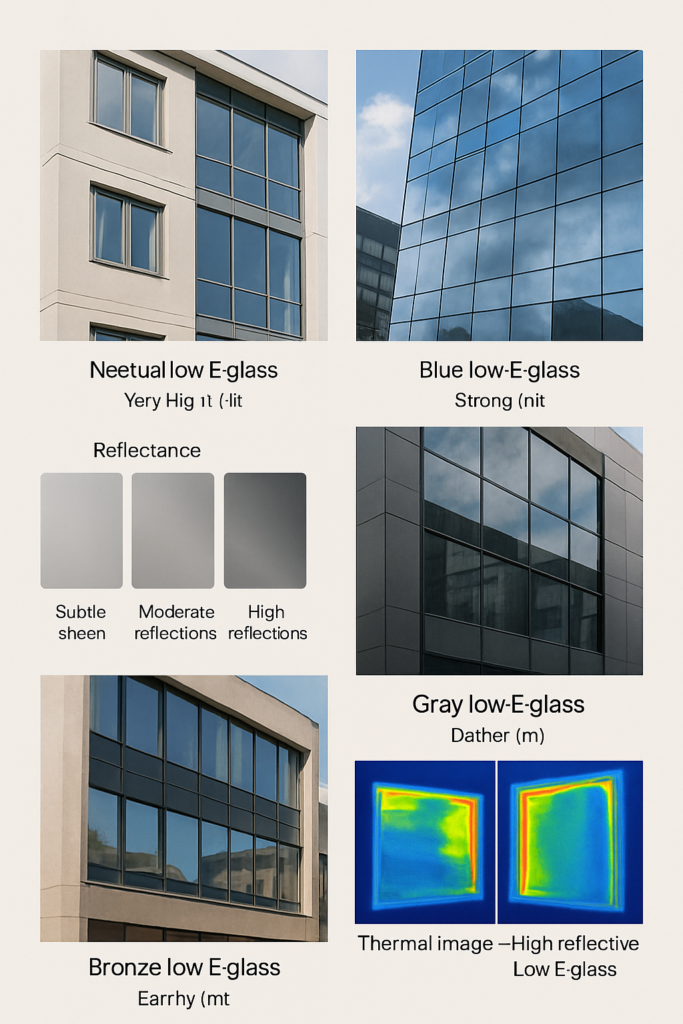
2.1 Neutral / Clear Low Emissivity Glass
Neutral low emissivity glass is designed to look as close as possible to ordinary clear glass while delivering high performance. Key traits:
- Colour: Very slight green, grey or blue cast, often only visible when compared side-by-side with uncoated glass.
- Use case: When the design brief calls for “glass that doesn’t look coated” but still needs strong insulation and solar control.
- Benefits:
- Excellent daylight and colour rendering inside.
- Minimal change to views or interior material tones.
- Works well for residential windows, heritage-sensitive projects and high-end storefronts.
If your priority is interior comfort and energy savings without a “high-tech” façade appearance, neutral low emissivity glass is usually the starting point. For more on how this directly affects comfort, see
Why Does Low Emissivity Glass Improve Indoor Comfort?
2.2 Blue and Blue-Green Low Emissivity Glass
Blue and blue-green variants are popular for contemporary commercial façades and high-rise residential towers.
- Colour: Cool, clean tones ranging from very pale blue to pronounced turquoise.
- Perception:
- Reads as fresh and modern.
- Pairs well with aluminium, stainless steel and light stone.
- Performance:
- Often combined with strong solar control, ideal for sunny exposures.
- Can feel slightly “cooler” inside due to colour bias in transmitted light.
These options are commonly chosen for projects where the façade wants to stand out against the skyline while still providing strong glare and heat control.
2.3 Grey Low Emissivity Glass
Grey-tinted low emissivity glass sits in the middle ground between neutral and strongly coloured.
- Colour: Smoky grey, sometimes with a subtle green or blue undertone.
- Benefits:
- Good for reducing glare without a dramatic colour statement.
- Works well with both warm and cool exterior materials.
- Can create a quiet, sophisticated appearance on corporate or institutional buildings.
Because grey absorbs more light than neutral coatings, it can slightly darken interiors. The trade-off is more comfortable luminance levels in highly glazed workspaces – especially when paired with coatings tuned for solar control, as discussed in
Low Emissivity Glass and Its Daylight–Solar Control Balance
2.4 Bronze and Earth-Toned Low Emissivity Glass
Bronze or brown-tinted low emissivity glass is less common in ultra-modern projects, but still highly relevant where architecture needs a warm, contextual feel.
- Colour: Warm brown, amber or bronze.
- Ideal for:
- Blending with brick, timber and natural stone.
- Projects in landscapes where deep blue-green glass would feel too cold.
- Comfort impact:
- Bronze tints cut glare effectively.
- Interiors feel warmer in tone, reinforcing a cosy atmosphere even in minimalist spaces.
This family is often chosen on residential developments and hospitality projects where designers want glazing that sits comfortably within natural surroundings. For urban planners thinking at district scale, the way façade colours integrate with streetscape and planting strategies connects directly with broader ideas in
Define Landscape Solutions in Smart Cities
3. Understanding Reflective Options: From Subtle Sheen to Mirror Finish
Colour is only half of the story. Reflectivity—how mirror-like the glass looks from outside—has a major impact on both design and comfort.
3.1 Low-Reflectance Low Emissivity Glass
- Appearance: Soft, almost matte; you see into the building more than you see reflections.
- Best for:
- Residential façades where occupants want visual connection with outdoors.
- Streets with pedestrian interest, where shopfronts and lobbies should feel open.
- Technical note:
- These coatings are engineered to minimise visible light reflection while still reflecting infrared heat, so performance is maintained.
Low-reflectance options pair particularly well with neutral or grey colour families when the priority is a “transparent” look with modern performance.
3.2 Medium Reflectance – Balanced Privacy and Openness
Medium-reflectance low emissivity glass is the sweet spot for many commercial buildings.
- Appearance: Reflections are clearly visible in the façade, especially at shallow angles, but interiors are still legible under normal daylight.
- Benefits:
- Offers a degree of daytime privacy for offices and meeting rooms.
- Creates dynamic facades that respond to sky conditions – buildings subtly change look across the day.
- Helps mitigate direct glare into interiors, particularly on sunny western exposures.
Medium reflectance is often combined with double-silver or triple-silver low emissivity coatings that deliver strong solar control without overly darkening the glass.
3.3 High Reflectance – Mirrored Low Emissivity Glass
At the extreme end are high-reflectance or “mirror” low emissivity glass options.
- Appearance: Façade behaves like a large mirror, especially during the day when exterior light levels are higher than inside.
- Uses:
- Landmark buildings where a high-tech or sculptural expression is desired.
- Situations where maximum daytime privacy is essential.
- Considerations:
- May increase the risk of glare for neighbouring properties or drivers.
- Interior spaces can feel more enclosed, particularly at night when reflections reverse.
High-reflectance options must be chosen carefully in urban contexts, and often require coordination with planners and environmental consultants.
4. How Coating Stacks Influence Color and Reflectance
Most modern low emissivity glass uses single, double or triple silver coatings. The number and arrangement of these silver layers determine:
- Colour neutrality vs. tint
- Reflectivity from inside and outside
- Light-to-solar-gain ratio (LSG) – how efficiently the glass admits light relative to heat
4.1 Single-Silver Coatings
- Pros:
- Cost-effective.
- Moderate improvement in U-value and SHGC.
- Cons:
- Tend to show more colour (often green or blue).
- Lower LSG ratios compared with higher-silver options.
Suitable for projects where budget is tight but some performance uplift is needed over standard clear glass.
4.2 Double-Silver Coatings
- Pros:
- Strong balance between natural light and solar control.
- Wide range of neutral, grey, blue and bronze options.
- Medium reflectance that suits most commercial façades.
- Use cases:
- Office buildings, mixed-use developments and high-end residential.
- West and south façades in warm climates.
4.3 Triple-Silver Coatings
- Pros:
- Highest performance: very low SHGC with high visible light transmittance.
- Ideal where you want clear-looking glass that still rejects a big percentage of solar heat.
- Cons:
- Higher material cost.
- Typically more sensitive to processing and IGU build-up.
These coatings are an excellent fit for high-performance envelopes that target aggressive energy codes or green building ratings, particularly when large glass areas are unavoidable. They also tie directly to strategies that lower operational emissions, as discussed in
How Does Low Emissivity Glass Reduce Environmental Impact?
5. Matching Color and Reflectance to Project Type
When specifying low emissivity glass, it’s helpful to think about use case, context and comfort goals together.
5.1 Residential Homes and Small Multi-Unit Buildings
- Recommended palette:
- Neutral or light grey low emissivity glass.
- Low to medium reflectance.
- Why:
- Maintains a “domestic” look rather than a corporate façade.
- Supports indoor comfort with stable temperatures and good daylight, which you can explore further in
Why Does Low Emissivity Glass Improve Indoor Comfort?
- Tips:
- Use stronger solar-control tints only on very exposed facades.
- For heritage streetscapes, warm neutrals or soft bronze can blend better with existing materials.
5.2 Commercial Offices and Mixed-Use Developments
- Recommended palette:
- Neutral, blue or grey low emissivity glass with medium reflectance.
- Double- or triple-silver coatings for high-performance façades.
- Why:
- Balances daylight, solar control and professional aesthetics.
- Creates a dynamic façade that responds to sky while giving occupants visual comfort at workstations.
Here it’s especially important to coordinate low emissivity glass choices with shading systems and overall façade strategy to hit both comfort and energy targets. For guidance on that balance, see
Low Emissivity Glass and Its Daylight–Solar Control Balance
5.3 Public Buildings, Retail and Cultural Projects
- Recommended palette:
- Neutral or slightly warm tints with low reflectance where visual openness is key.
- Stronger colour statements (blue, green, bronze) when the building should act as a visual landmark.
- Considerations:
- Visitor experience: entrance lobbies and galleries benefit from clear, bright glazing.
- Urban integration: façade colour and reflectance should respect surrounding streets, planting and civic spaces—again tying into broader urban design thinking like that in
Define Landscape Solutions in Smart Cities
6. Practical Tips for Evaluating Colour and Reflective Options
Because glass appearance changes with angle, light and background, always:
- View full-size mock-ups
Small samples can be misleading. Ask for IGU mock-ups installed outdoors so you can assess real-world colour and reflectivity. - Check from inside and outside
Comfort and appearance are two sides of the same coin—make sure the glazing feels good from the occupant’s perspective as well as in elevation. - Compare at different times of day
Early morning, midday and late afternoon light will each reveal different aspects of colour and reflectance. - Coordinate with interior finishes
Blue-biased glass will interact differently with warm timber or cool stone; mock-ups should include key interior materials. - Balance aesthetics with performance
If a very dark or reflective glass is being considered solely for glare control, check whether a higher-performing low emissivity coating combined with shading could achieve the same comfort with a lighter, friendlier appearance.
Conclusion: Performance First, Appearance Never Second
Today’s low emissivity glass no longer forces a choice between energy efficiency and design intent. From ultra-neutral low-reflectance units to bold blue or bronze façades with mirror-like finishes, there is a wide spectrum of colors and reflective options that can be tuned to your project’s climate, comfort requirements and architectural vision.
The key is to:
- Decide how much daylight, solar control and privacy you need.
- Choose a coating family (single, double, triple silver) that meets performance goals.
- Then refine colour and reflectance to fit the building’s character and its urban or natural setting.
Handled thoughtfully, low emissivity glass becomes more than just a technical upgrade—it becomes a core design material that shapes how people experience light, temperature and views in and around your building for decades to come.