
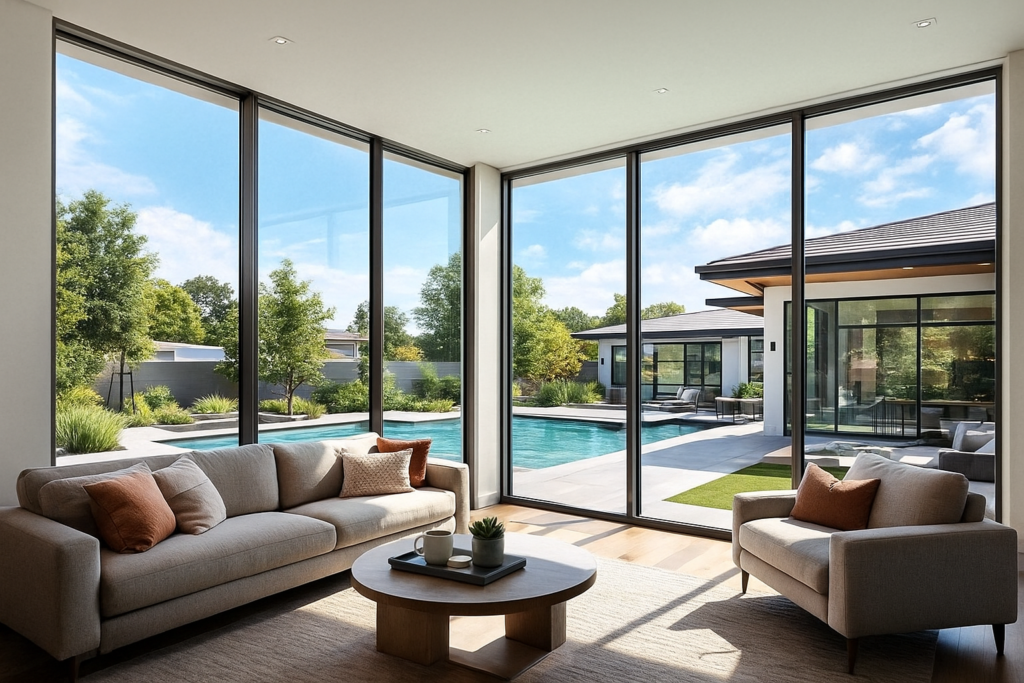
If your home gets a lot of sun, your windows are doing more than just framing a view—they’re actively shaping comfort, bills, and even how long your furnishings last. That’s where low emissivity glass comes in.
But not all Low-E is the same. Some types are designed to welcome solar heat into the home (great for cold but sunny climates), while others are tuned to block it (ideal for hot, high-sun regions). Choosing the wrong type for a high solar gain home can mean glare, overheating, and wasted energy.
This guide walks through which Low E glass types work best for high solar gain homes, how they behave with strong sun exposure, and how to choose the right configuration for your project.
1. What Is Low Emissivity Glass – and Why It Matters in High Solar Gain Homes?
Low emissivity glass (Low-E glass) has a microscopically thin metallic or metal-oxide coating that:
- Reflects infrared (IR) heat (both from the sun and from inside your home)
- Reduces UV transmission that fades fabrics and floors
- Still allows plenty of visible light to pass through
In plain language: with low emissivity glass, you can let light in without letting heat and UV run wild.
In high solar gain homes—properties with:
- Large areas of glazing
- South- or west-facing elevations
- Minimal shading
- Locations with strong sun (cold-but-sunny or hot climates)
…choosing the right Low-E type is critical. The goal is to decide whether your glass should harvest that solar energy (for passive heating) or reject it (for cooling and comfort).
2. Solar Gain 101: What “High Solar Gain” Really Means
Solar energy comes in three main bands:
- Ultraviolet (UV) – causes fading and damage
- Visible light – what you see and want for daylight
- Infrared (IR) – what you feel as heat
“High solar gain” homes are those that:
- Receive strong direct sunlight for many hours per day
- Have large window-to-wall ratios
- Often rely on solar exposure for heating (cold climates) or struggle with overheating (hot climates)
With low emissivity glass, you can tune how your windows handle:
- Solar Heat Gain Coefficient (SHGC): how much solar energy is admitted
- U-value: how well the glass resists heat flow
- Visible Light Transmittance (VLT): how bright the interior feels
The right combination depends heavily on your climate and design intent.
3. Two Main Families: Passive vs Solar-Control Low E Coatings
When you strip away the jargon, most low emissivity glass used in homes falls into two performance categories:
3.1 Passive (High Solar Gain) Low E Glass
Best for:
Cold or very cool climates with lots of sunshine (e.g., cold continental or alpine regions).
What it does:
- Lets in more solar heat (higher SHGC) to help warm the home
- Still reduces heat loss at night or in winter through a low U-value
- Often placed on the 3rd or 4th surface of a double- or triple-glazed IGU to retain indoor heat
When to choose it:
- You want to capture as much free winter sun as possible
- Overheating risk is low or can be managed with shading (eaves, blinds, landscaping)
- Your main problem is heating demand, not cooling
In other words, if your “high solar gain home” is in a cold but sunny climate, passive Low-E types are ideal. You’re intentionally using the sun as part of your heating strategy.
3.2 Solar-Control (Low Solar Gain) Low E Glass
Best for:
Warm, hot, or mixed climates where overheating and glare are big problems.
What it does:
- Uses spectrally selective coatings to block more solar heat (lower SHGC)
- Maintains good VLT, so rooms stay bright without becoming ovens
- Typically applied on the 2nd surface of an IGU (just inside the outer pane) to reflect heat away before it enters
When to choose it:
- Your main problem is too much solar heat and high cooling bills
- You want to tame west- and south-facing glazing in hot or mixed climates
- You still want clear views and natural daylight, not dark, heavily tinted glass
If your high solar gain home gets strong summer sun and struggles with overheating, solar-control Low-E types are usually the best fit.
4. Coating Complexity: Single, Double & Triple Silver Low E
Within both passive and solar-control families, modern low emissivity glass comes in different coating “stacks,” often described as:
- Single-silver Low-E
- Double-silver Low-E
- Triple-silver Low-E
Each additional silver layer generally:
- Improves selectivity (better ratio of light to heat)
- Lowers SHGC (more heat rejection) without killing daylight
- Increases material cost
For high solar gain homes, think of them like this:
- Single-silver Low-E
- Softer solar control
- Good for cooler climates that still want useful winter solar gain
- Double-silver Low-E
- Stronger solar control with good daylight
- Often the “sweet spot” for mixed or warm climates
- Triple-silver Low-E
- Very high performance, great for extreme sun exposure (large west-facing facades, hot climates)
- Best when overheating and glare are serious issues
Triple-silver options are especially attractive in large, sun-exposed façades where you want:
- Bright interiors
- Low cooling loads
- Minimal glare
5. Matching Low E Glass Types to Your High Solar Gain Home
Let’s put it all together in practical “if this, then that” terms.
Scenario 1: Cold Climate + Large South-Facing Windows
- You want solar gain in winter
- Summers are short or mild
- Risk of serious overheating is limited
Best choice:
- Passive Low-E glass with:
- Higher SHGC (0.45–0.60, depending on code and comfort)
- Low U-value for night and winter insulation
- Often single- or double-silver coatings
- Coated on the 3rd or 4th surface
Your windows become “solar radiators” in winter while still limiting night-time heat loss.
Scenario 2: Hot Climate + Strong East/West Sun
- Long, hot summers
- Rooms overheat in the afternoon
- Cooling load dominates
Best choice:
- Solar-control Low-E glass with:
- Low SHGC (typically 0.20–0.35)
- Good VLT to avoid dark interiors
- Double- or triple-silver coatings
- Coated on the 2nd surface
This setup rejects a big chunk of solar heat before it ever reaches the interior, especially valuable on west-facing walls.
Scenario 3: Mixed Climate + All-Day Sun Exposure
- Four seasons with both heating and cooling needs
- Large glazing, maybe on multiple orientations
- You want a balanced solution
Best choice:
- Balanced solar-control Low-E with:
- Moderate SHGC (~0.30–0.45)
- Low U-value
- Double-silver coating often works very well here
This type of low emissivity glass smooths out extremes in both winter and summer without committing too far in one direction.
6. Other Factors That Influence the “Best” Low E Glass Type
Even for high solar gain homes, the glazing choice isn’t just about the coating. Consider:
6.1 Glazing Configuration
- Double vs triple glazing:
- Triple glazing offers lower U-values and better comfort near glass, especially in cold climates.
- Double glazing with high-performance Low-E and gas fill often gives the best value in milder or warm climates.
6.2 Gas Fill (Argon, Krypton)
- Argon is common and cost-effective for improving insulation.
- Krypton can be used in thinner cavities or very high-performance units.
6.3 Frame Performance
There’s no point investing in premium low emissivity glass if the frame is a thermal weak point. Look for:
- Thermally broken aluminum
- High-performance uPVC or composite frames
- Quality weather seals
6.4 Shading, Overhangs & Landscaping
Even the best glass benefits from external shading:
- Overhangs sized for your latitude
- Louvres and brise-soleil
- Strategic planting (trees, green façades)
If you’re thinking about how glazing interacts with your broader urban or site strategy, it’s worth looking at Define Landscape Solutions in Smart Cities for ideas on how greenery, streetscapes, and shading can work with high-performance glass.
7. Design & Installation: Don’t Forget the “How”
Getting the type right is only half the battle. The glass must also be:
- Correctly specified (coating type, SHGC, U-value, surface position)
- Correctly installed (orientation, seal quality, frame integration)
For deeper guidance on the design side, see:
- How to Specify Low Emissivity Glass in Architecture – helpful if you’re an architect, designer, or builder trying to match performance targets with real products.
And to make sure performance on paper actually shows up on site:
- What Steps Ensure Low Emissivity Glass Is Installed Correctly? – covers best practices for handling, orientation, sealing, and quality checks.
Bonus: if you’re also interested in how glazing choices affect sound inside high-sun spaces (big glass often means more noise paths), you can also explore:
8. Quick Decision Checklist for High Solar Gain Homes
Use this as a fast filter when choosing a low emissivity glass type:
- Climate:
- Cold & sunny → Passive Low-E, higher SHGC
- Hot or very warm → Solar-control Low-E, low SHGC
- Mixed climate → Balanced solar-control Low-E
- Orientation:
- Big south-facing glazing in cold climates → Capture solar gain
- Large west-facing glazing in hot climates → Strong solar control
- Comfort & Use:
- Living rooms and sunspaces → Balance warmth and glare control
- Bedrooms in hot climates → Favor cooler SHGC, strong solar control
- Home offices → Prioritise glare reduction and balanced daylight
- Budget & Payback:
- Double-silver solar control often offers the best cost–performance balance
- Triple-silver is excellent for extreme solar exposure or large glass walls
Final Thoughts
For high solar gain homes, the goal isn’t simply “Low-E or not,” but choosing the right Low-E type for your climate, orientation, and comfort goals.
- In cold but sunny regions, passive, higher-SHGC Low-E glass turns your windows into solar assets.
- In hot or sun-baked climates, spectrally selective solar-control Low-E keeps interiors cool without sacrificing daylight.
- In mixed climates, balanced Low-E options help smooth out seasonal extremes and stabilise comfort year-round.
Get the type, configuration, and installation right, and your low emissivity glass becomes a long-term partner in comfort, efficiency, and sustainable design.