
Modern architecture demands glazing solutions that balance aesthetics with performance. As buildings increasingly adopt larger glass surfaces, energy efficiency becomes a critical concern. One of the best solutions is glass low E, which incorporates a thin metallic coating that reflects heat and filters harmful radiation without blocking natural light.
But how do we measure its performance? The answer lies in a set of ratings and performance metrics that define the efficiency of Low-E glass. Understanding these ratings helps homeowners, architects, and builders choose the right glazing for their projects.
In this article, we’ll explore which ratings define glass low E energy efficiency, why they matter, and how they align with building codes and sustainable design goals.
What Is Glass Low E?
Glass low E (short for low-emissivity glass) is engineered with microscopically thin metallic coatings—often silver—that manage the way glass interacts with energy.
- In winter: Reflects indoor heat back inside, improving insulation.
- In summer: Reduces solar heat gain, keeping interiors cool.
- Year-round: Blocks UV radiation while preserving clarity and daylight.
Because of these properties, Low-E glass is essential for achieving compliance with modern building codes and sustainability benchmarks.
Why Ratings Matter for Glass Low E
Ratings translate the science of glass performance into measurable values. They allow regulators, manufacturers, and consumers to compare products and determine if a glass system meets requirements for:
- Energy codes
- Comfort goals
- Environmental certifications (e.g., LEED, BREEAM)
- Long-term building performance
Without ratings, choosing the right glass would be a guessing game.
The Key Ratings That Define Glass Low E Efficiency
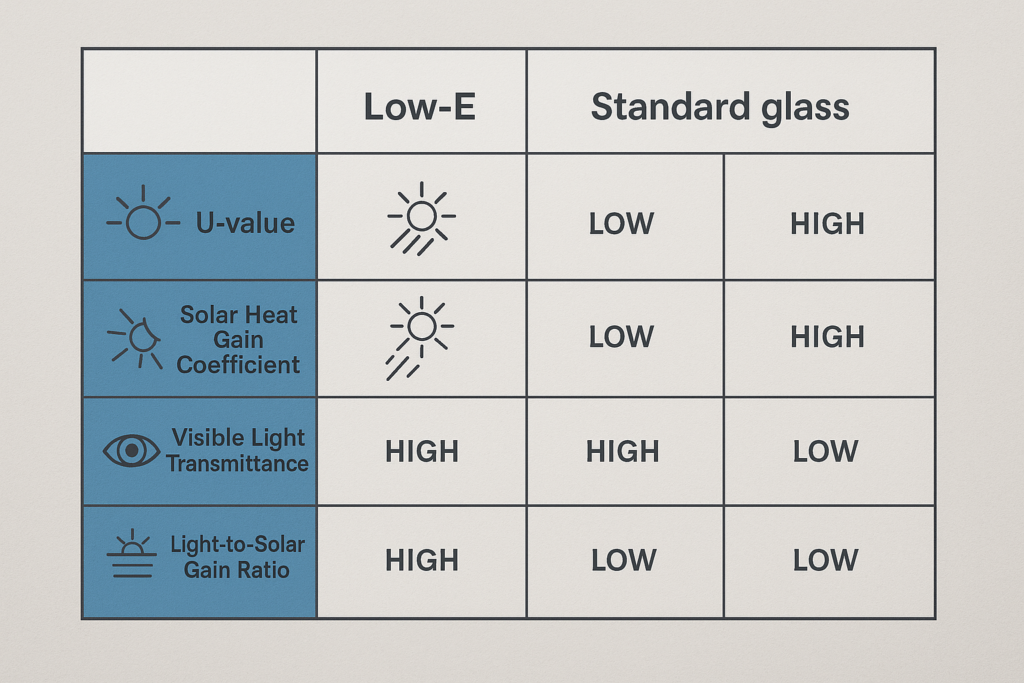
1. U-Value (Thermal Transmittance)
- Definition: Measures how much heat passes through a glass unit.
- Scale: Lower U-values = better insulation.
- Relevance: Essential for cold climates where heat loss is a major issue.
For example, standard single-pane glass has a U-value around 5.0 W/m²K, while Low-E double glazing can reduce this to 1.0–1.5 W/m²K.
2. Solar Heat Gain Coefficient (SHGC)
- Definition: Fraction of solar radiation transmitted through the glass.
- Scale: Lower SHGC = less solar heat gain.
- Relevance: Critical in hot climates where cooling loads dominate.
A typical SHGC for standard clear glass is 0.85, whereas Low-E glass can bring this down to 0.25–0.40 depending on coatings.
3. Visible Light Transmittance (VLT)
- Definition: The percentage of visible light that passes through the glass.
- Scale: Higher VLT = brighter interiors.
- Relevance: Ensures that glass still provides natural daylight while balancing energy efficiency.
Low-E glass typically achieves VLT values of 60–75%, preserving bright, open interiors.
4. Emissivity (ε)
- Definition: The ability of a surface to radiate energy.
- Scale: Lower emissivity = better reflection of infrared radiation.
- Relevance: Defines how effective Low-E coatings are at insulating buildings.
Clear uncoated glass has an emissivity of about 0.84, while soft-coat Low-E glass can be as low as 0.02–0.04.
5. Light-to-Solar Gain Ratio (LSG)
- Definition: Ratio of VLT to SHGC.
- Scale: Higher ratios = better “spectral selectivity.”
- Relevance: Indicates how well the glass admits light while blocking heat.
The U.S. Department of Energy sets 1.25 as the threshold for glazing to qualify as spectrally selective.
How Ratings Relate to Building Codes
Modern codes around the world require windows to meet specific performance thresholds. These requirements nearly always rely on Low-E glass to comply.
- IECC (USA): U-value and SHGC limits vary by climate zone.
- NBC (Canada): Requires improved thermal performance in residential windows.
- EU EPBD: Demands glazing with low U-values and SHGC values.
- Australia NCC: Section J mandates efficient glazing for commercial projects.
For a deeper dive into regulation, see What Building Codes Require Glass Low E in Windows?.
Applications of Low-E Glass Defined by Ratings
Skylights
Require balance between VLT for daylight and SHGC for solar control. Learn more in Why Should Glass Low E Be Chosen for Skylight Use?.
Sliding Doors
Large panels need low U-values for insulation and low SHGC for comfort. See When Is Glass Low E Preferred in Sliding Door Design?.
Tall Facades
Commercial facades must balance aesthetics with spectral selectivity (LSG). Discover more in What Makes Glass Low E Ideal for Tall Glass Facades?.
Installation and Handling Considerations
Performance ratings mean little if the glass is damaged or poorly installed. Handling large Low-E panels requires specialized tools:
- Use miter clamps for safe lifting and movement on-site.
- Employ Vacuum Lifter systems for large facade and skylight installations.
Proper installation ensures the glass performs to its rated specifications.
Environmental Value of Low-E Ratings
Ratings not only support compliance but also demonstrate how glass low E reduces environmental impact:
- Lower energy demand: Reduced reliance on heating and cooling systems.
- Carbon footprint reduction: Supports net-zero and sustainable building initiatives.
- Extended lifespan: Protects interiors, reducing replacement and waste.
For broader sustainable design ideas, see Define Landscape Concepts in Modern Architecture.
Future of Low-E Glass Ratings
As energy standards evolve, expect ratings for glass to become stricter. Future innovations may include:
- Triple silver Low-E coatings for even lower SHGC and U-values.
- Smart glass integration for adaptive control of SHGC and VLT.
- AI-based performance monitoring to ensure real-world values match rated performance.
Conclusion
Glass low E energy efficiency is defined by ratings such as U-value, SHGC, VLT, emissivity, and LSG. These metrics quantify how well the glass insulates, controls solar gain, admits daylight, and blocks UV radiation.
Building codes worldwide now rely on these ratings to enforce energy performance standards, making Low-E glazing a requirement in most projects. From skylights and sliding doors to tall facades, Low-E ratings ensure that glass delivers both comfort and sustainability.
When combined with proper miter clamps and Vacuum Lifter installation practices, glass low E becomes not just a building material, but a key driver of energy-efficient, future-ready architecture.